
The 6 Key Components of an Effective Product Brainstorming Session
Nov 21, 2025 | 2 min read

You know the feeling. Your team gathers for a 鈥渂rainstorming鈥� session, but half the room is quiet, ideas repeat themselves, and the energy fades fast. You leave wondering if anything meaningful came from it.
Brainstorming should be exciting, collaborative, and productive, but too often, it鈥檚 not. At 麻豆传媒AV在线看, my team has helped hundreds of organizations鈥攆rom startups to Fortune 500s鈥攗nlock new ideas and get aligned around the right ones. We鈥檝e seen what works (and what kills creativity). This post will break down what makes a brainstorming session truly effective so you can do the same in your organization.
Here鈥檚 what I鈥檒l cover:
- What a product brainstorming session is (and why it matters)
- When and how to hold one
- Who should be in the room
- How to structure and facilitate it听
- What to do after it鈥檚 done听
- When to bring in outside help
What Is a Product Brainstorming Session, and Why Does It Matter?
A product brainstorming session is a focused, collaborative meeting where team members generate and refine ideas for new products, features, or solutions.
But it鈥檚 not just 鈥渢hrowing ideas on a whiteboard.鈥� These sessions are about spending quality time developing 鈥渄ivergent鈥� ideas to ensure that when the team 鈥渃onverges鈥� on a select few concepts, no stone was left unturned.
In engineering and product development, a good brainstorming session brings together people from different disciplines鈥攄esigners, engineers, marketers, and even manufacturing leads鈥攖o solve complex problems faster and more creatively.
It matters because early collaboration reduces blind spots and helps the team align before major design or cost decisions are made. In our experience, skipping this step can lead to rework, misalignment, or missed opportunities later in development.
When Should You Hold a Brainstorming Session?
The best time is when you鈥檝e defined a problem clearly but haven鈥檛 locked in on a path forward. It鈥檚 not an exact science, but if you鈥檙e too early, your ideas may lack direction. Too late, and people may already be attached to solutions.
Some good moments are:
- After research or discovery, when insights are fresh听
- When you鈥檝e hit a design roadblock and need new angles听
- Before major concept development or prototyping听
Who Should Be in the Room for an Effective Brainstorming Session?
A great session depends on who鈥檚 there and how safe they feel contributing.
Typically, you should have a mix of:
- Core team members (engineers, designers, project leads) who know the constraints听
- Cross-functional voices (manufacturing, marketing, service) who add real-world perspectives. Unless you鈥檙e dealing with confidentiality limitations, you want to avoid limiting participation to only technical experts because outside perspectives are typically less biased, better represent the voice of the customer, and are often the ones that lead to unexpected, but brilliant, breakthroughs.听
- A facilitator鈥攕omeone who guides the flow and keeps the conversation balanced听and involved听
Regardless of team or title, psychological safety in the brainstorming room is important. Everyone should feel free to share ideas without fear of judgement or being shot down.听
How Do You Prepare for a Product Brainstorming Session?
Many brainstorming sessions fail because teams 鈥渏ust wing it.鈥� Here鈥檚 how to set the stage:听听
- Clarify your goal. Are you solving a design challenge? Generating new concepts? Improving an existing feature?听
- Define the problem clearly. A strong 鈥淗ow might we…鈥� statement keeps discussion focused. This definition significantly drives the direction of ideas produced. Too focused, and you get similar solutions across contributors, too large, and you鈥檙e likely to produce ideas beyond the desired scope.听
- Bring the right data. Include research, user feedback, surveys, etc. Sketches and prototypes make for great visual aids but be careful to indicate what is and what is not required in these concepts to avoid 鈥減utting ideas into a box.鈥澨�
- Set an agenda. Block time for warm-up, ideation, discussion, and next steps.听听
- Choose your tools. Whether in person or virtual, have whiteboards, sticky notes, or Miro ready.听听
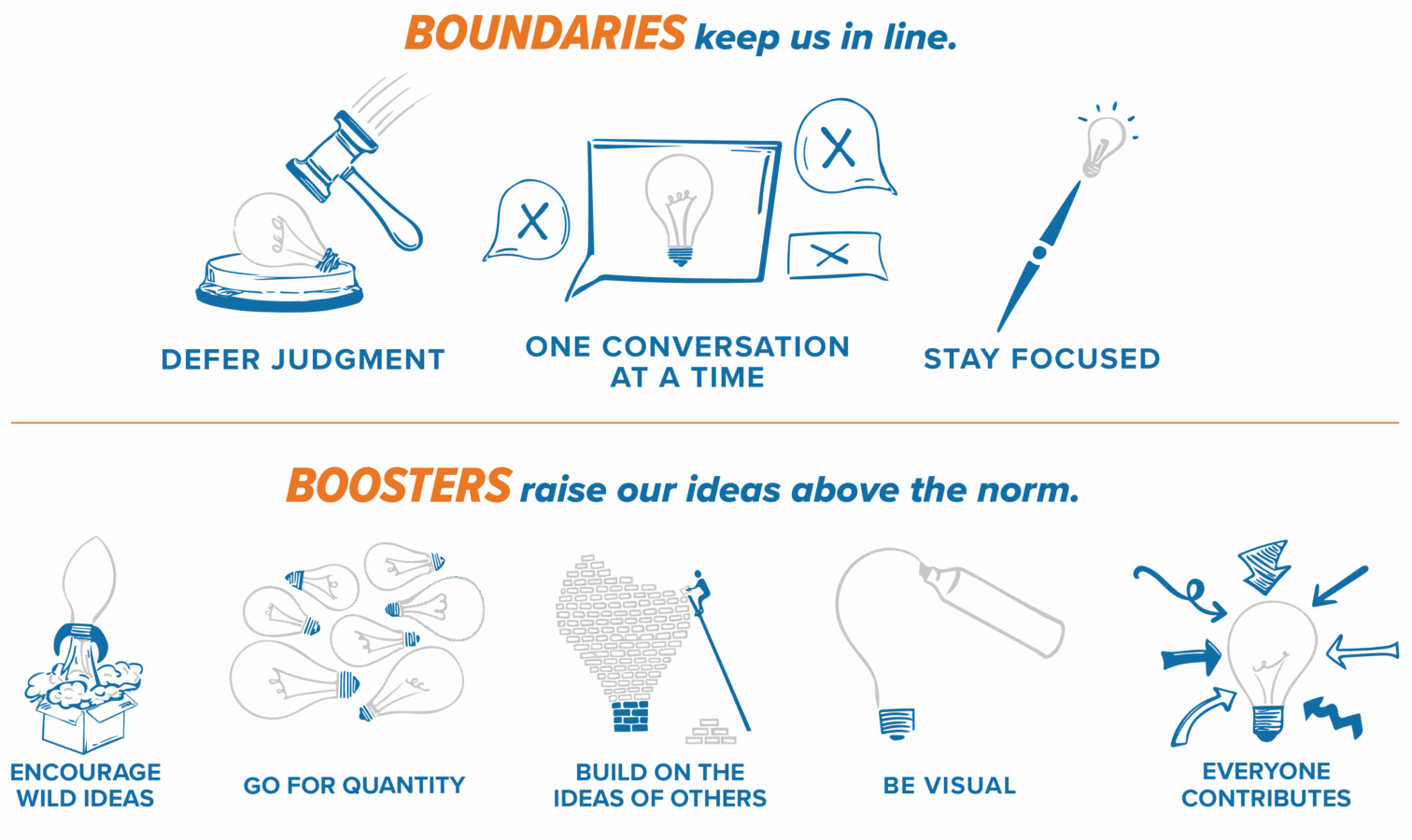
A well-prepared session creates freedom. It鈥檚 not structure for its own sake, but boundaries that focus creativity where it matters. For example, these are the boosters and boundaries we use during our brainstorming sessions:听
The 6 Key Components of an Effective Brainstorming Session
Here鈥檚 how to structure your session for success.听听
1. Start with the Problem
Revisit the challenge or opportunity to make sure everyone is aligned. Keep it visible throughout the session.听
2. Warm Up the Room
Simple creative exercises or quick 鈥渂ad idea鈥� rounds lower the pressure and open people up.听
3. Generate Ideas
Use methods like:听听
- SCAMPER (Substitute, Combine, Adapt, Modify, Put to another Use, Eliminate, Reverse)听
- Rapid ideation: Time sprints with as many ideas as possible听
- Silent brainstorming: Everyone writes ideas individually before group sharing听
4. Discuss and Build
Encourage 鈥測es, and鈥� thinking. Combine ideas or evolve them together. It鈥檚 important for the facilitator to guide this portion well to ensure voices are heard and don鈥檛 devolve into judgements which stifle others from openly sharing.听
5. Evaluate and Prioritize
Cluster similar ideas and identify the most promising based on feasibility, impact, and alignment with goals. It鈥檚 vital that this convergent process happens as a group as well.听
6. Capture Everything
Document every idea, even the wild ones. You can do this by taking notes, or sometimes pictures are better because your brainstorming might include drawings or visuals.听听
How Do You Keep a Brainstorming Session Productive and Avoid Groupthink?
Groupthink is the silent killer of innovation. When people feel pressured to agree, great ideas never surface.
Here鈥檚 how to keep energy and creativity high:
- Rotate voices: Don鈥檛 let the loudest dominate. Invite quieter team members to share.听
- Use timeboxing: Keep each phase short and focused.听听
- Encourage quantity over quality (for the divergent phase of ideating).听
- Hold feedback until later: Evaluation too soon can kill momentum.听
- Appoint a facilitator: This person should be neutral鈥攏ot the boss or decision-maker.听
Bringing in an external facilitator can be a good idea in some scenarios. They鈥檙e unbiased, trained to draw out every voice, and help your team see ideas from new angles.听听
What Happens After a Brainstorm? Turning Ideas into Real Product Concepts
A brainstorm isn鈥檛 over when the meeting ends! Without follow-up, even the best ideas can disappear into notebooks.
Here鈥檚 what should happen next:
- Organize the ideas. Group similar ones and identify themes.听
- Evaluate feasibility. Which ideas are realistic given your time, cost, and resources?听
- Select top concepts. Decide which to prototype or explore further.听
- Assign ownership. Someone should always own the 鈥渘ext step.鈥澨�
Use a simple matrix to score ideas on impact vs. effort. It鈥檚 a quick way to spot the most valuable opportunities.听听
When Should You Bring in a Third-party Facilitator?
Even the most capable and creative teams can benefit from an outde perspective. You might consider external facilitation when:听听
- Internal dynamics limit creativity or honest discussion听
- You鈥檙e tackling a high-stakes or strategic product challenge听
- You want to build team alignment across departments听
A third-party facilitator can push thinking further, ask hard questions, and make sure all ideas get heard.
Our team at 麻豆传媒AV在线看 often partners with teams at this stage, acting as both a catalyst and a neutral guide. We help clients discover new directions they might not have seen from the inside.
听
Get Better Ideas from Your Next Brainstorming Session
You now know what makes a product brainstorming session truly effective, from preparation to facilitation and all the way through follow-up.
If your team鈥檚 sessions feel stale or repetitive, it might be time for a reset. My team at 麻豆传媒AV在线看 would love to lead your next ideation session and hopefully drive better collaboration and results. You can contact us online here to get one scheduled.
Written By:

Andrew Hemphill
Concept Engineer
DISHER Newsletter
Sign up to receive articles and insights, delivered monthly.
Schedule a no-committment project call
Reach out to discuss your project to find out if DISHER could be a good fit for you.