
The Benefits and Types of Manufacturing Automation in 2026
Jun 19, 2026 | 2 min read

Most manufacturers aren’t asking “should we automate?� anymore. That conversation has moved on. The question now is whether your automation strategy is actually delivering the results you expected — and for many operations, the honest answer is: not entirely.
In our work with manufacturers across medical device, food and beverage, automotive, and industrial markets, we’re seeing a consistent pattern. Companies that invested in automation over the last few years are now at an inflection point. Some have captured the productivity gains they were after. Others are managing systems that are harder to maintain than anticipated, or finding that the ROI projections on paper didn’t quite match the production floor reality.
If you’re evaluating new automation investments — or taking a hard look at what’s working in your existing setup — this article covers the core benefits, the main types of automation systems, and where AI-driven automation fits into the picture in 2026.
Key Takeaways
- Automation delivers the strongest ROI in high-volume, repeatable, well-defined processes — but what’s “ready to automate� has shifted with AI-assisted tooling.
- AI and machine learning are now embedded in automation systems, not add-ons. They’re changing what’s possible in quality inspection, predictive maintenance, and process optimization.
- The manufacturers seeing the best outcomes treated automation as a strategy, not a purchase — starting with process clarity before committing to technology.
- Not every task belongs on the automation list. See our companion article on what manufacturing tasks shouldn’t be automated
What Is Manufacturing Automation?

Manufacturing automation is the use of machines, software, and control systems to perform production tasks with minimal human intervention. The goal is to increase efficiency, consistency, and output while reducing reliance on manual labor for repetitive or hazardous tasks.
In practice, automation touches nearly every part of a production operation: assembly, inspection, material handling, data collection, maintenance monitoring, and more. What’s changed in recent years is the accessibility. Systems that once required significant capital investment — industrial robots, vision systems, SCADA platforms — are now available at price points that work for small and mid-sized manufacturers, not just large OEMs.
Accessibility hasn’t made the decisions easier, though. If anything, more options create more complexity — which is why a clear-eyed view of the benefits and tradeoffs still matters.
7 Benefits of Manufacturing Automation
The core value proposition of automation hasn’t changed, but the mechanisms delivering those benefits have evolved considerably.
1. Increased Productivity
Automated systems run continuously at consistent speeds, without the variability that comes from human fatigue or shift changes. In high-volume production environments, even modest cycle time reductions compound quickly. Modern automation systems can also self-adjust in real time based on sensor data, maintaining throughput even as conditions on the line shift.
2. Improved Quality and Consistency
Automation removes human variability from repetitive tasks, which translates directly to more consistent output. AI-powered vision systems have substantially raised the bar here — modern systems can detect surface defects, dimensional deviations, and assembly errors at speeds and accuracy levels no manual inspection process can match, particularly for well-defined defect profiles.
3. Cost Reduction
The labor cost equation is the most visible driver, but not the only one. Automation also reduces scrap and rework, lowers the cost of quality escapes, and — with predictive maintenance capabilities — reduces unplanned downtime. The total cost of ownership calculation is more complex than it used to be, which is one reason ROI projections don’t always match reality without careful planning.
4. Increased Workplace Safety
Automating ergonomically demanding, repetitive, or hazardous tasks reduces injury risk and the associated costs. Collaborative robots (cobots) have made this more practical in environments where full automation isn’t feasible — they can take over high-repetition, high-strain tasks while workers focus on judgment-intensive roles.
5. Higher Employee Engagement
When automation takes over monotonous tasks, it frees your team for work that requires skill, problem-solving, and judgment. That shift tends to improve engagement and retention — two things that matter in a labor market that remains tight for skilled manufacturing roles. The framing of “automation vs. workers� is increasingly being replaced by “automation and workers,� with technology designed to augment human capability rather than simply eliminate roles.
6. Flexibility and Scalability
Modern automation systems — particularly programmable and flexible systems — can be reconfigured to handle product variation and changing demand. This is a significant departure from earlier generations of fixed automation, where a production change could require substantial re-engineering. The ability to scale capacity up or down without proportional labor changes is increasingly important for manufacturers managing volatile demand.
7. Data and Continuous Improvement
Automated systems generate data continuously — cycle times, defect rates, machine states, throughput. When that data feeds into a SCADA or MES platform, it creates a foundation for continuous improvement that’s difficult to replicate with manual processes. The manufacturers getting the most out of their automation investments typically treat that data as a strategic asset, not just a monitoring feed.
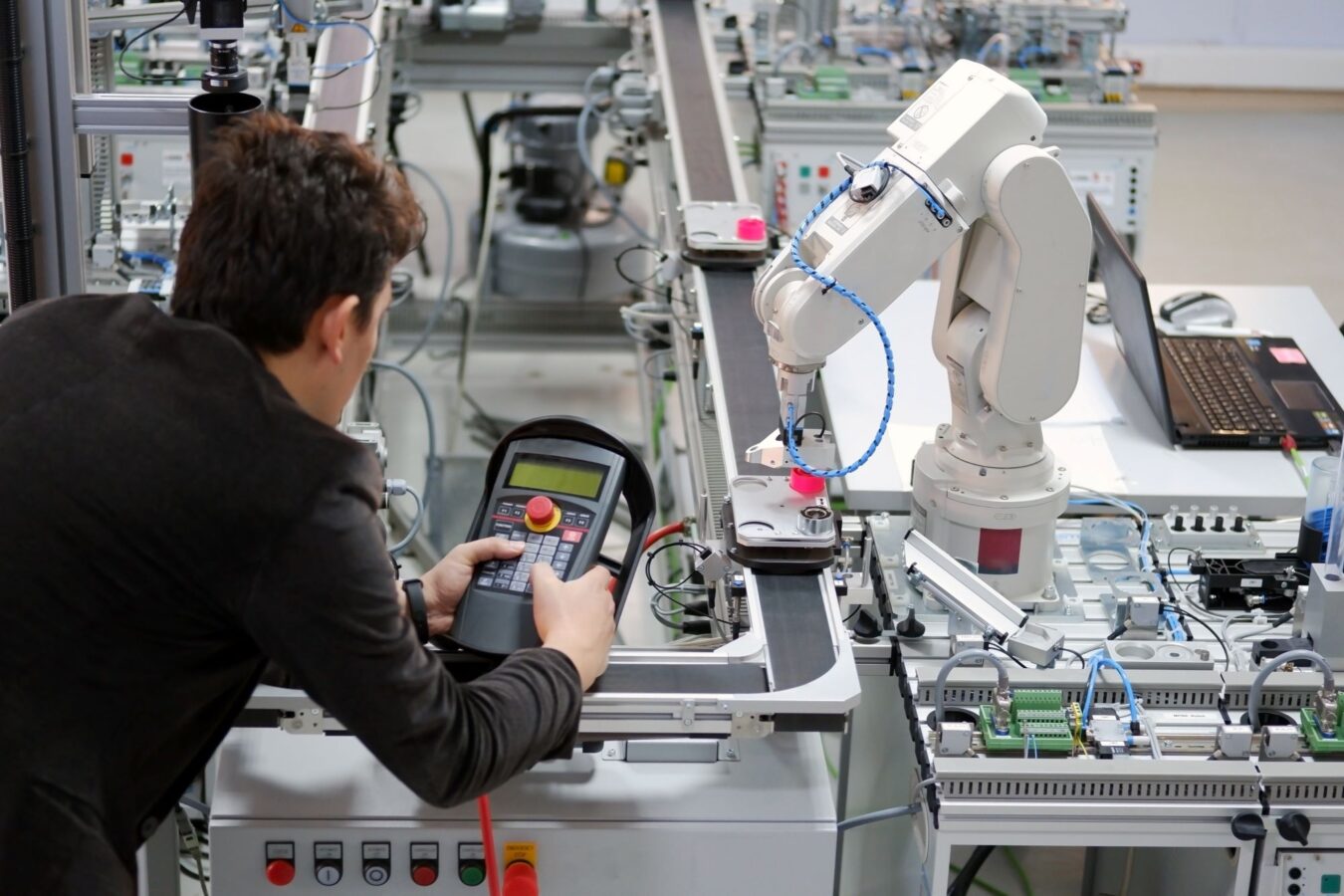
5 Types of Manufacturing Automation Systems
The right automation system depends on your specific process, volume, and variability. Here’s a practical breakdown of the main categories.
1. Fixed Automation
Designed for a specific, repeating task with minimal variation. Assembly lines, conveyor systems, and dedicated robotic cells fall here. Best suited for high-volume, stable production environments where the task definition won’t change. High throughput, lower flexibility.
2. Programmable Automation
Systems that can be reprogrammed or reconfigured to handle different tasks or product variants. Industrial robots and CNC machines are the most common examples. More flexible than fixed automation, with some added complexity in changeover.
3. Flexible (Soft) Automation
Combines the efficiency of fixed automation with the adaptability of programmable systems. Automated Guided Vehicles (AGVs), Autonomous Mobile Robots (AMRs), and Automated Storage and Retrieval Systems (AS/RS) are prime examples. Particularly well-suited for environments with frequent product changeovers or mixed-model production.
4. Integrated Automation
Connects multiple automation technologies — sensors, PLCs, robots, vision systems, SCADA — into a unified system where data and control flow seamlessly between components. This is where operational intelligence comes from: not individual machines running well, but systems that communicate and self-optimize. Integrated automation is the backbone of smart manufacturing.
5. Collaborative Automation (Cobots)
Collaborative robots work alongside human operators safely, sharing tasks and adapting to human presence. Cobot pricing has dropped significantly, and programming interfaces have become far more accessible — deployment timelines that once took months can now take weeks in straightforward applications. They’re well-suited for high-mix, lower-volume environments where full automation is cost-prohibitive.
AI-Driven Automation: What’s Different Now
Artificial intelligence has moved from a buzzword in manufacturing conversations to a functional component of automation systems. It’s now embedded in the tools and platforms manufacturers are already using. A few areas where this is making a practical difference:
Smarter Quality Inspection
Machine learning models running against sensor data can identify failure signatures before a breakdown occurs. The practical value isn’t just fewer surprise failures — it’s the shift from reactive and scheduled maintenance toward condition-based maintenance, which reduces both unplanned downtime and unnecessary preventive work.
Process Optimization
AI-assisted process monitoring can identify correlations between process parameters and output quality that wouldn’t surface in standard SPC data. For complex processes with many interacting variables — injection molding, welding, precision machining — this can yield meaningful quality and yield improvements without major capital investment.
Smarter AMR Navigation
AMRs now use AI-based navigation that allows them to operate in dynamic environments without fixed infrastructure. Unlike earlier AGVs requiring magnetic tape or embedded guides, AMRs can reroute around obstacles and adapt to changing floor layouts — meaningfully reducing deployment complexity.

How to Think Â鶹´«Ã½AVÔÚÏß¿´ Automation More Strategically
The manufacturers getting the best results from automation share some common characteristics in how they approach it:
- Start with the process, not the technology. Before evaluating any system, make sure the process is well-documented, stable, and optimized. Automating a broken or inconsistent process just makes that problem faster and more expensive to fix.
- Map variability honestly. High variability isn’t an automatic disqualifier, but it has to be understood and accounted for. If you’re not sure how variable the process is, find out before you commit.
- Pilot before you scale. What looks clean on paper often looks different when running in a production environment. Test your assumptions on a smaller scale before committing to a full implementation.
- Design for human-machine collaboration. The strongest automation strategies are ones where technology handles what it does best — speed, repeatability, data capture — and humans handle what they do best: judgment, adaptability, communication.
- Don’t automate the wrong things. There are tasks where human capability genuinely outperforms automation, and where the cost of getting it wrong is high. See our article on what manufacturing tasks shouldn’t be automated for a full breakdown.
How DISHER Can Help
¶Ù±õ³§±á·¡¸é’s automation engineering team works with manufacturers across industries to design, build, and integrate automation solutions that are matched to the actual process. We don’t come in with a preferred technology or a one-size-fits-all playbook. We start by understanding your operation.
Our process:

- Facility walk and stakeholder interviews to understand your current state and pain points
- Process assessment and variability mapping
- Identification of the highest-value automation opportunities
- Technology-agnostic recommendations with ROI modeling
- Engineering, integration, and deployment — or augmentation of your existing team with the specific expertise you need
Whether you need a single engineer to fill a skills gap or a full cross-functional team to take a project from scope to deployment, we scale to match what your project actually needs.
Ready to take a closer look at your automation strategy? Connect with us here.
Written By:

Devin Brown
Automation Engineer
DISHER Newsletter
Sign up to receive articles and insights, delivered monthly.
Schedule a no-committment project call
Reach out to discuss your project to find out if DISHER could be a good fit for you.